
I stepped out of a narrow street in the Kasbah, past a modest arched gate with a bilingual “Badii Palace / Palais Badii” plaque bolted to the pisé wall, and into a corridor so narrow and so tall that I actually stopped walking. Two rammed-earth walls rose on either side of me, high enough to block most of the sky, funneling toward a bright rectangle of daylight at the far end. That corridor is the first thing most visitors experience at El Badi Palace, and it sets the tone for everything that follows: this is a ruin built on an almost unbelievable scale, and the emptiness is the point.
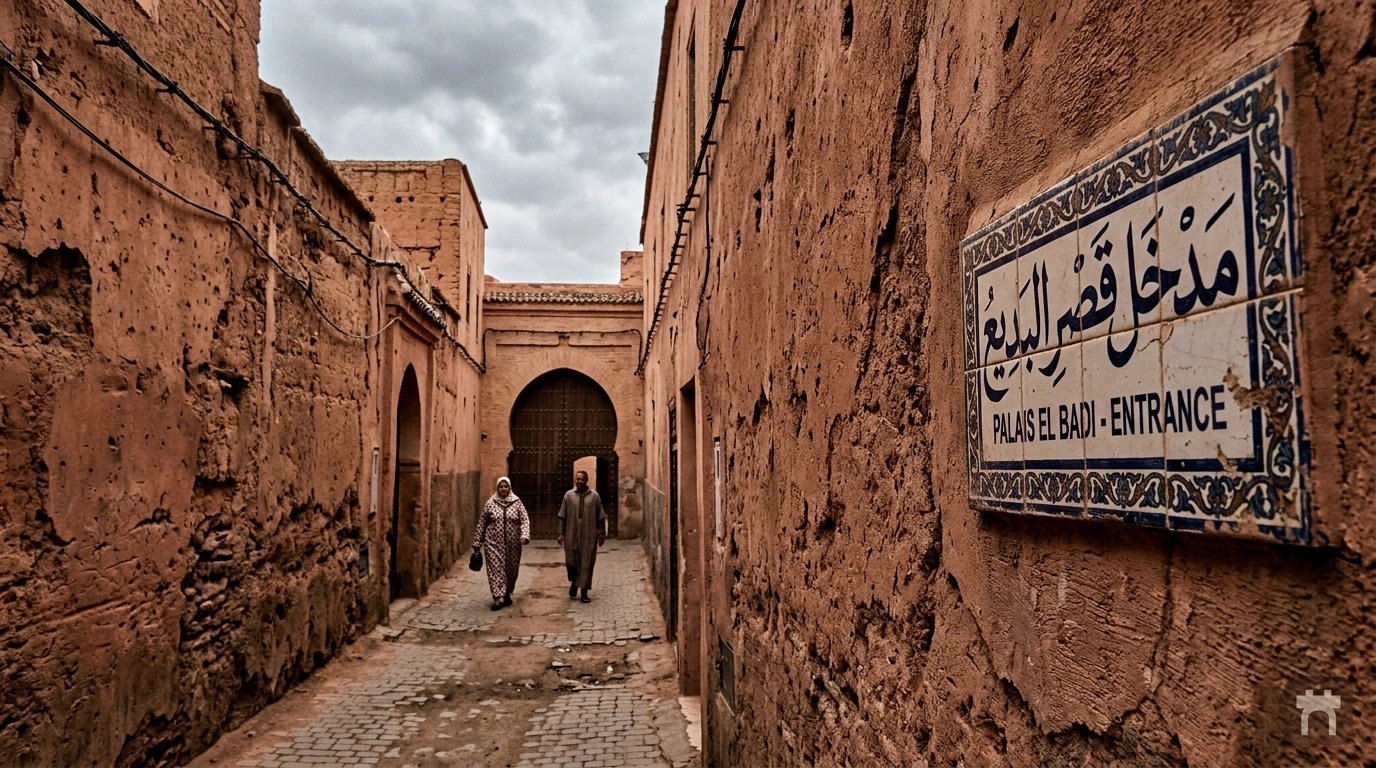
You can see it in the photo above: the walls are close enough that the passage feels almost claustrophobic, but they’re also several storeys high, which is the first hint of just how large the rest of the complex is going to be.
This guide covers everything I’d want to know before going: what the entrance fee actually is, how long to plan, what you’ll really see once you’re inside, and how it fits into a wider day in the Kasbah district.
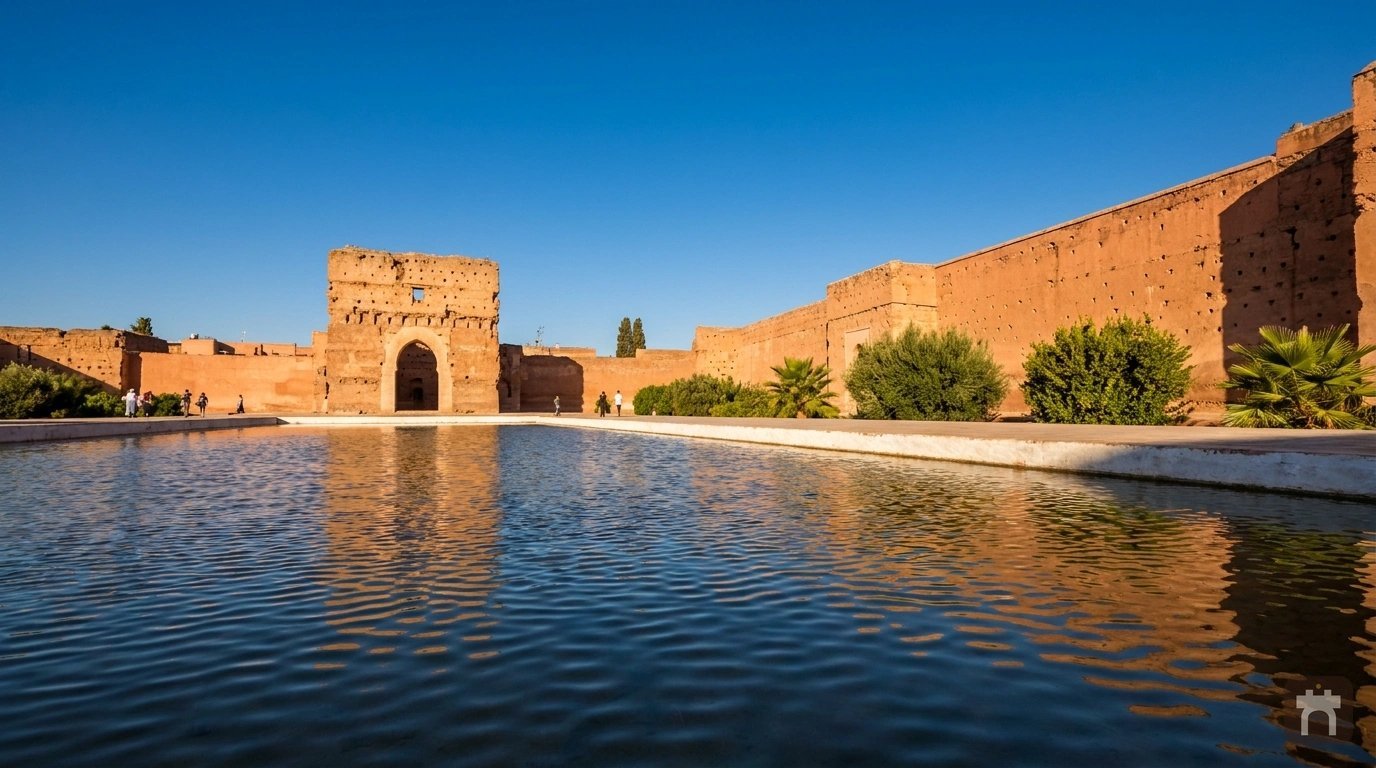
I’d read plenty about El Badi being “just a ruin” before I went, and that description undersells it. A ruin implies something accidental, like a building that simply fell down. El Badi didn’t fall down — it was deliberately, systematically dismantled, and what’s left is the shell of something built at a scale that’s hard to grasp from photos alone. Standing in the main courtyard for the first time, with pisé walls rising several storeys on every side and storks circling overhead, is a different experience than the pictures suggest.
Quick Facts
- Hours: 9:00 AM–5:00 PM daily (last entry around 4:30 PM)
- Price: 100 MAD for foreign visitors, 30 MAD for Moroccan citizens and residents with a CIN, free for children under 12
- Suggested duration: 1 to 1.5 hours
- Location: Ksibat Nhass, Kasbah district, about 5 minutes from Place des Ferblantiers
- Built: 1578–1603 by the Saadian sultan Ahmad al-Mansur
For the full breakdown of prices, how tickets are sold, and tips on timing, see our dedicated El Badi Palace tickets page and our guide to El Badi Palace opening hours.
A Palace Built to Announce a Kingdom
El Badi means “the Incomparable,” and it was never meant to be modest. Sultan Ahmad al-Mansur began building it in 1578, fresh off a decisive victory at the Battle of the Three Kings, and spent roughly 25 years on it — importing Carrara marble from Italy (reportedly traded weight-for-weight for Moroccan sugar) and gold carried by caravan from Timbuktu. I read the trilingual plaque just inside the entrance, which puts it plainly: the palace once had four grand pavilions supported by marble columns, zellij tilework, sculpted plaster, and painted wood. Almost none of that survives today, because a century later Sultan Moulay Ismail stripped the palace down to its bones to build his own capital at Meknes. I go into the full story, and why he left the walls standing, in our piece on El Badi Palace history.
What’s left in place is mostly structural: the massive rammed-earth ramparts, the arched gateways, and the footprint of the courtyard itself. Everything portable and valuable — marble columns, cedar ceilings, gilded stucco, painted zellij — was carted north to Meknes over roughly a decade. It’s an odd thing to process while walking around: you’re not looking at decline through neglect, you’re looking at the aftermath of a very deliberate, very thorough removal job carried out by order of a rival sultan.
Practical Tips From an Actual Visit
A few things I wish I’d known walking in:
- Wear proper shoes. Much of the site is uneven pisé, stone, and gravel, including the excavated sections below floor level and the stairs down into the sunken gardens.
- The rooftop stairs are steep and unshaded. Worth it for the view, but not effortless, especially at midday.
- Bring cash in dirhams. Tickets are sold at the gate only, and card payment isn’t reliably available.
- The minbar pavilion and underground photo gallery are easy to miss. They’re set slightly apart from the main courtyard, and a surprising number of visitors head straight for the pool and the rooftop without seeing either.
- Storks are visible year-round, nesting directly on the ramparts, and you don’t need any special timing to spot them.
What You’ll Actually See Inside
The main courtyard is the headline: a rectangular expanse roughly 135 by 110 metres, framed by towering pisé walls pockmarked with rows of small arched niches (they once held decorative khaysuran reed screens). A long reflecting pool — close to 90 metres — runs along one side, and standing at its edge I watched the walls mirror perfectly in the still water, storks visible on the ramparts above.
Beyond the courtyard there’s more than most visitors expect:
- The sunken orange gardens, planted below the level of the main courtyard, still bearing fruit
- A smaller drained basin with its original green-and-white checkerboard mosaic intact
- An excavated section below floor level, where you can walk among partition walls and see the original zellij paving up close
- The minbar pavilion, home to the 12th-century Koutoubia minbar, a carved wooden pulpit made in Córdoba around 1137 — centuries older than the palace itself
- A vaulted underground gallery, now used to display black-and-white photographs of old Marrakech
- The rooftop terrace, with views over the whole complex toward the city and the Atlas Mountains on a clear day
I cover each of these in more depth, including exactly where to find them, in our guide to things to see inside El Badi Palace and our overview of El Badi Palace architecture.
The underground gallery is worth calling out specifically, because it’s easy to walk past. It’s a vaulted, cave-like corridor running beneath part of the complex, currently used to display old black-and-white photographs of Marrakech life — market scenes, street portraits, the city as it looked generations ago. The contrast between the rough, curved pisé ceiling overhead and the framed photographs on the walls is one of the more unexpectedly memorable corners of the whole site, and most people rushing between the pool and the rooftop terrace miss it entirely.
Getting There and Tickets
El Badi Palace sits in the Kasbah district, an easy walk from Place des Ferblantiers and a short taxi ride from the Medina or Gueliz. Tickets are sold only at the gate — there’s no official online booking for individual visitors — so bring cash in dirhams. Full walking, taxi, and parking details are in our guide on how to get to El Badi Palace, and if you’re driving, see parking near El Badi Palace. For the current entrance fee breakdown, always check our El Badi Palace tickets page before you go, since official rates can change.
When to Go
Morning light, roughly between 9 and 11am, is when the pisé walls and the reflecting pool look their best, and the site is quietest. I’ve written a full breakdown of seasonal considerations and time-of-day tradeoffs in the best time to visit El Badi Palace.
Is It Worth Visiting?
Given that so little of the original decoration survives, this is a fair question — I answer it honestly, with the tradeoffs, in is El Badi Palace worth visiting. Short version: if you want intact craftsmanship, Bahia Palace does that better; if you want scale, atmosphere, and a genuine sense of a dynasty’s rise and fall, El Badi delivers something Bahia can’t. I compare the two directly in El Badi Palace vs Bahia Palace.
Planning Around the Visit
A few more pieces worth reading before you go: what to do if you’re visiting with kids, whether a guided tour is worth arranging, where to eat afterward in our restaurants near El Badi Palace guide, and where to stay nearby in hotels near El Badi Palace. If you’re building out a longer day, see our one-day Marrakech itinerary including El Badi Palace and top attractions near El Badi Palace. For a quick reference of dates, dimensions, and other numbers, keep our El Badi Palace facts page bookmarked.
Frequently Asked Questions
How much time do I need at El Badi Palace? Budget 1 to 1.5 hours for a relaxed visit that covers the main courtyard, the minbar pavilion, the underground gallery, and the rooftop terrace.
Is El Badi Palace worth visiting if it’s just a ruin? Yes — the scale of the courtyard, the nesting storks, and the surviving Koutoubia minbar make it one of the most atmospheric sites in Marrakech, even without intact interior decoration.
What is the entrance fee for El Badi Palace? 100 MAD for foreign visitors and 30 MAD for Moroccan citizens and residents with a CIN; children under 12 enter free. See our El Badi Palace tickets page for full details.