
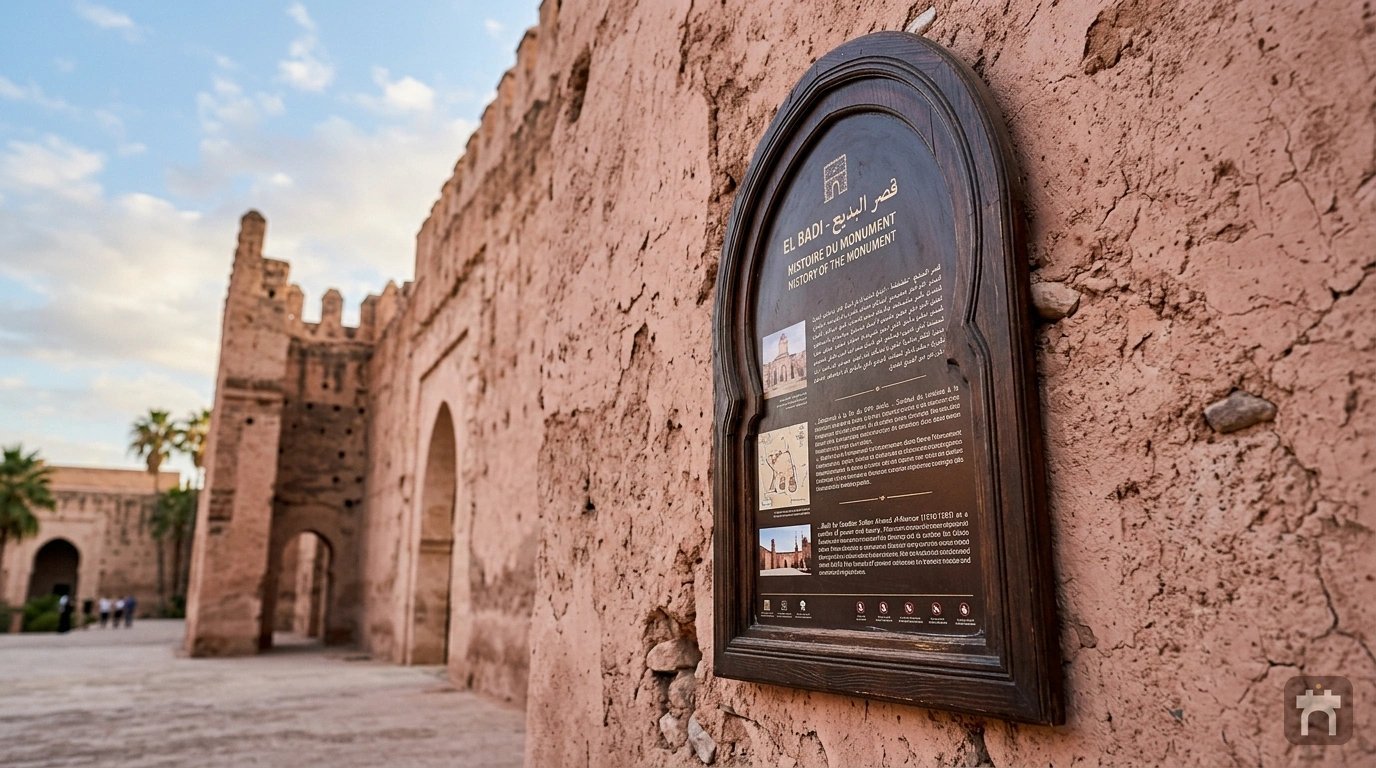
I kept a running list of numbers while walking through El Badi Palace, partly because the scale is hard to hold in your head otherwise. Here’s the reference version — the key facts and figures worth knowing, whether you’re planning a visit or just researching the site.
Most of these numbers come from a mix of historical accounts and the trilingual information panel posted at the entrance, which summarizes the palace’s own history in French, English, and Arabic. Where sources give slightly different figures — as often happens with a building this old — I’ve used the most commonly cited version.
Naming
- Also spelled: Badii Palace, Badi’a Palace, El Badia Palace, El Badi Palace — all referring to the same site, with the official Ministry of Culture signage using “Badii Palace”
- French name: Palais El Badi
- Local pronunciation note: the stress falls on the second syllable, roughly “el-BAH-dee”
Construction
- Built: 1578–1603 (roughly 25 years)
- Commissioned by: Sultan Ahmad al-Mansur of the Saadian dynasty
- Funded by: Wealth and prestige gained after the Battle of the Three Kings (1578)
- Materials imported: Carrara marble from Italy (reportedly traded for its weight in Moroccan sugar) and gold carried by caravan from Timbuktu
- Meaning of the name: “El Badi” translates to “the Incomparable”
Scale
- Main courtyard: roughly 135 by 110 metres
- Reflecting pool: nearly 90 metres long
- Original room count: approximately 360 rooms
- Original pavilions: four grand pavilions, including the Crystal Pavilion and the Pavilion of Audiences, supported by marble columns
Decline
- Stripped by: Sultan Moulay Ismail, starting in the 1670s–1680s
- Reason: Materials — marble, cedar beams, gilded stucco, tilework — were relocated to build Moulay Ismail’s new capital at Meknes
- Duration of dismantling: roughly a decade
- What survived: the massive pisé (rammed-earth) ramparts, too heavy and structural to be worth removing
Notable Surviving Object
- The Koutoubia minbar: a carved wooden pulpit made in Córdoba around 1137 for Marrakech’s Koutoubia Mosque — about 440 years older than El Badi Palace itself, now displayed in its own pavilion on site
Visiting Today
- Hours: 9:00 AM–5:00 PM daily, last entry around 4:30 PM
- Entrance fee: 100 MAD for foreign visitors, 30 MAD for Moroccan citizens and residents with a CIN, free for children under 12
- Location: Ksibat Nhass, Kasbah district, Marrakech, about 5 minutes’ walk from Place des Ferblantiers
- Suggested visit length: 1 to 1.5 hours
- Managed by: Morocco’s Ministry of Culture
Wildlife
- Storks: White storks nest on the ramparts year-round and are visible from the courtyard and rooftop without any special timing needed
Nearby Landmarks
- Bahia Palace: about a 10-minute walk, an intact 19th-century vizier’s residence
- Saadian Tombs: about an 8-minute walk, the restored burial chambers of the same dynasty that built El Badi
- Koutoubia Mosque: roughly 20–25 minutes on foot, the mosque the surviving minbar was originally carved for
For the full story behind these numbers — why the palace was built at this scale, and exactly how it came to be stripped — see our El Badi Palace history guide, and for a breakdown of the architecture itself, see El Badi Palace architecture.
Frequently Asked Questions
How many rooms did El Badi Palace originally have? Historical accounts put the original palace at roughly 360 rooms, arranged around the main courtyard and adjoining pavilions.
How long is the reflecting pool at El Badi Palace? The main reflecting pool runs close to 90 metres, alongside a courtyard measuring roughly 135 by 110 metres.
How old is the Koutoubia minbar inside El Badi Palace? It was carved around 1137 in Córdoba, making it roughly 440 years older than El Badi Palace itself. Current El Badi Palace tickets and hours are available on our tickets page.