
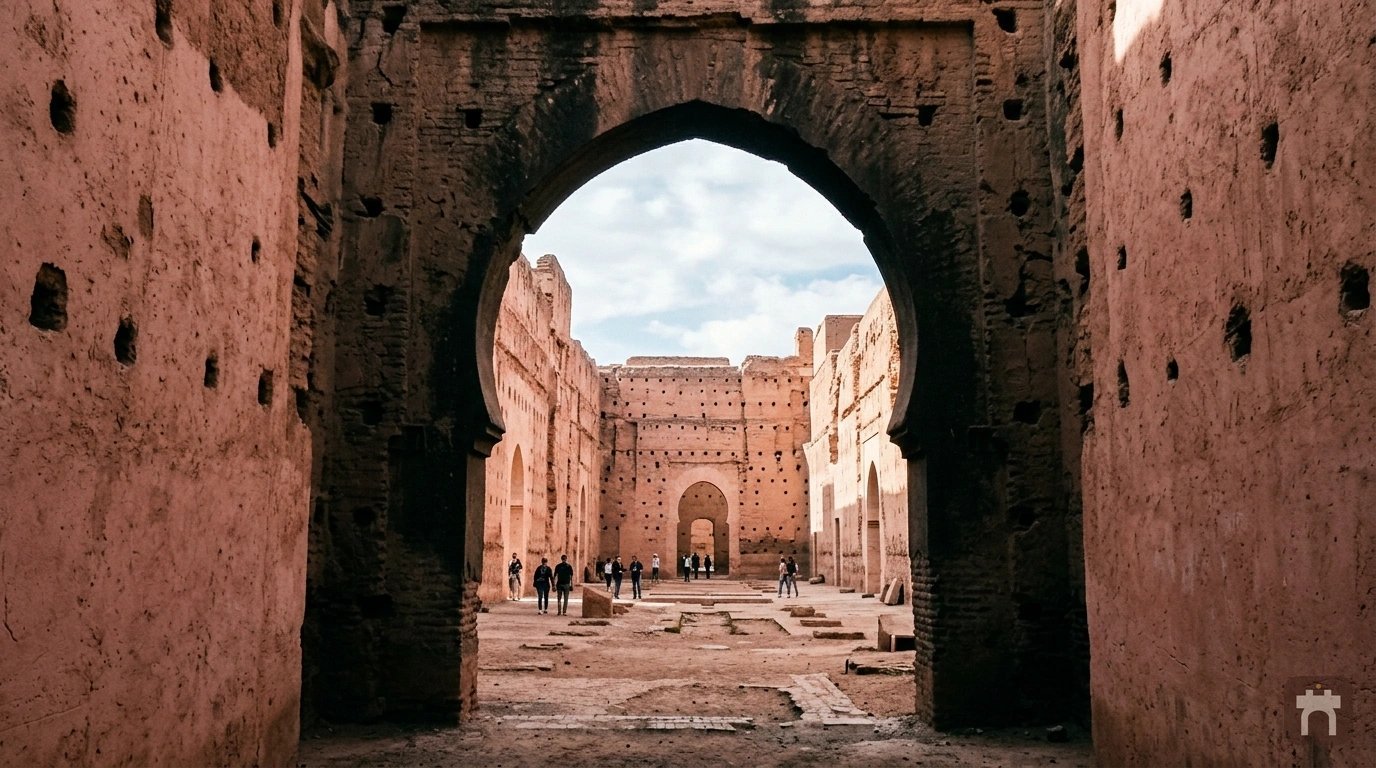
Standing beneath one of El Badi Palace’s rampart walls, looking straight up at rows of small dark niches running in even lines across the surface, I found myself trying to picture what was originally slotted into all of them. That texture — regular, deliberate, clearly structural rather than decorative — is really the architectural story of El Badi Palace as it exists today: almost everything you can see is what the building is made of, not what it was decorated with.
Pisé Construction
The surviving walls are built from pisé, or rammed earth: layers of compacted soil, sand, and lime packed into wooden formwork and left to harden into extremely dense, thick walls. This is a traditional building technique used widely across Morocco for structures that need to be massive and durable rather than light or delicate. It’s also precisely why so much of El Badi still stands: pisé walls are structural, not decorative, and far too heavy and integral to have been worth dismantling when Sultan Moulay Ismail stripped the palace’s finer materials for his new capital at Meknes.
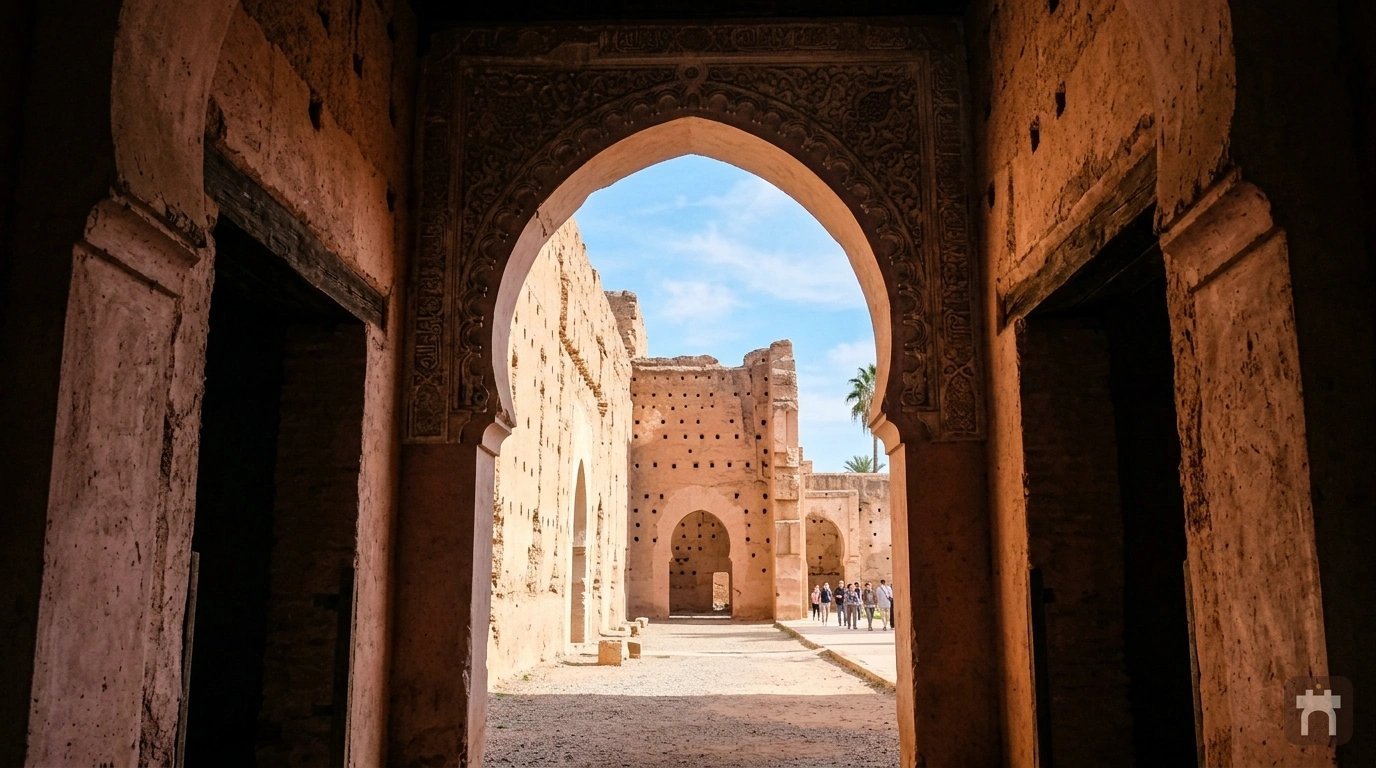
Those rows of small niches, visible in the photo above, run across nearly every rampart wall on the site. They likely held khaysuran — woven reed screens — used decoratively and functionally, along with sockets for scaffolding beams used both during original construction and later repair work.
Monumental Proportions
What El Badi’s architecture communicates most clearly, even stripped of decoration, is scale. The main courtyard measures roughly 135 by 110 metres, framed on all sides by ramparts several storeys high. A reflecting pool close to 90 metres long runs along one edge. These aren’t modest palace-garden dimensions — they’re closer to the scale of a public plaza, and walking the full perimeter takes real time, which was very likely the point: a Saadian sultan announcing his kingdom’s new power through architecture that visitors could feel physically, not just admire aesthetically.
What the Original Decoration Looked Like
According to historical accounts (and the palace’s own trilingual information panel at the entrance), the original El Badi featured four grand pavilions supported by marble columns, with walls covered in zellij tilework, carved and painted plaster, and painted cedar wood. Carrara marble was imported from Italy, reportedly traded weight-for-weight for Moroccan sugar. Almost none of this remains in place today — it was removed piece by piece over roughly a decade in the late 17th century.
Where the Original Materials Still Show
A handful of spots let you see fragments of that original decorative layer. In an excavated section of the courtyard, work has exposed the palace’s true original floor level, well below where visitors currently walk, and patches of green-and-white zellij tilework remain visible between low pisé partition walls marking out the original room layout. A smaller, drained basin elsewhere on the site retains its original checkerboard mosaic flooring intact.
The Minbar as an Architectural Outlier
The single most significant piece of surviving craftsmanship on site isn’t part of the palace’s original architecture at all: the Koutoubia minbar, a carved wooden pulpit made in Córdoba around 1137, predates El Badi by more than four centuries and was installed in its own dedicated pavilion long after the palace’s construction. Its dense, precise marquetry — geometric star patterns, inlaid ivory and silver — gives a sense of the craftsmanship level the palace’s own decoration would have matched when new. I cover its specific history in the Koutoubia minbar.
Reading the Ruin
Understanding El Badi’s architecture is largely about reading absence: the scale of what’s gone tells you as much as what remains. For the fuller historical arc behind why the palace looks the way it does today, see our El Badi Palace history guide.
Frequently Asked Questions
What material are the El Badi Palace walls made of? The surviving walls are pisé, or rammed earth — packed layers of compacted soil and lime that form extremely thick, durable structural walls, distinct from the marble and tile that once decorated the interiors.
What were the small holes in the walls used for? The rows of small arched niches and square holes visible across the walls held decorative reed screens called khaysuran, along with scaffolding beams used during construction and later repairs.
How big is the El Badi Palace courtyard? The main courtyard measures roughly 135 by 110 metres, with a reflecting pool running nearly 90 metres along one side. See it in person with El Badi Palace tickets, available daily at the gate.