
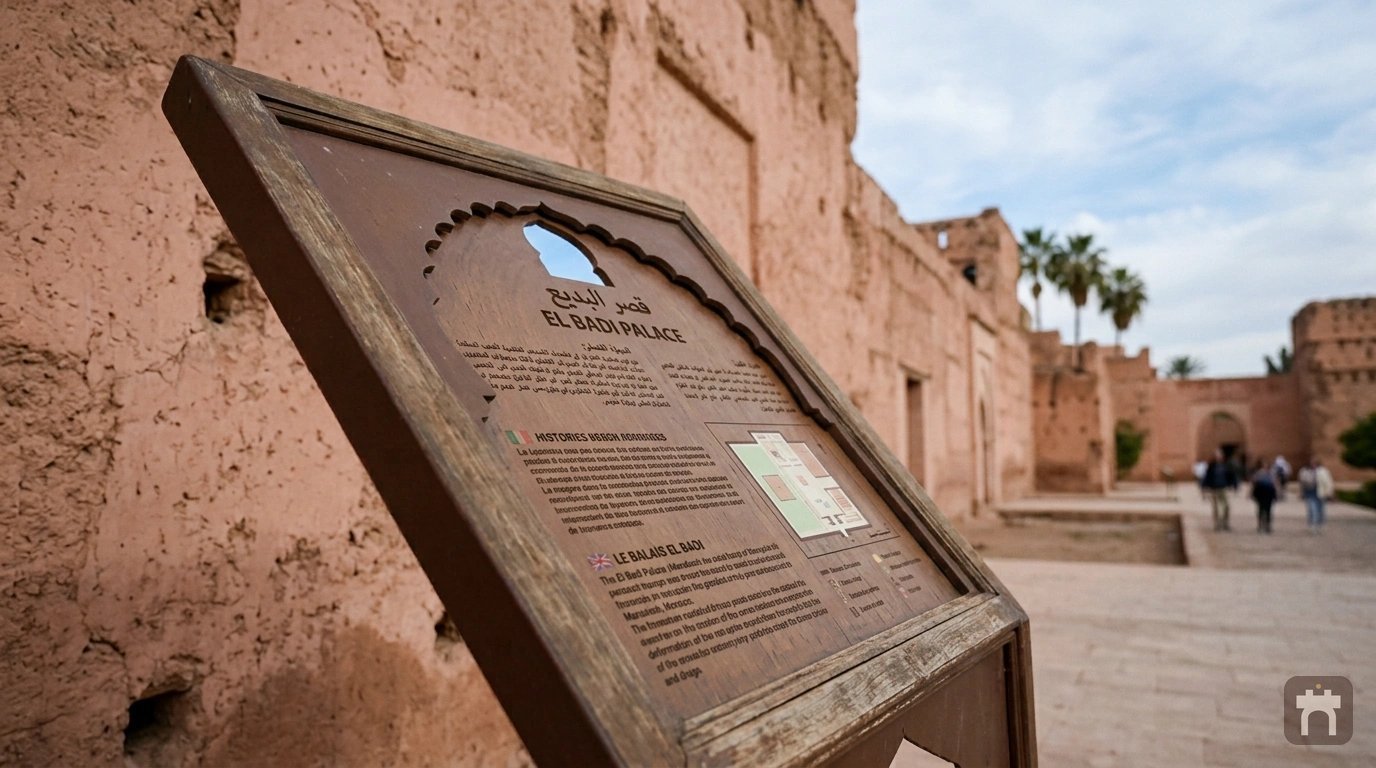
Right by the entrance, mounted on the pisé wall, there’s a trilingual information panel — French, English, and Arabic — written in the palace’s own voice: “I am the incomparable Badia Palace, built by the Saadian sultan Ahmed El Mansour over the course of his reign (1578–1603).” I stood and read the whole thing before going any further, because it lays out the history more concisely than most guidebooks manage, and it’s worth understanding before you walk through the rest of the site.
Built on the Winnings of a Battle
In 1578, Ahmad al-Mansur emerged from the Battle of the Three Kings — a battle in which three monarchs died and Morocco suddenly found itself a serious regional power — with ransom money, captured weapons, and enormous prestige. He used that wealth to build a palace meant to announce Morocco’s new standing to the world, and named it El Badi, “the Incomparable.”
Construction took around 25 years. Materials came from far beyond Morocco’s borders: Carrara marble shipped in from Italy, reportedly traded weight-for-weight for Moroccan sugar, and gold carried north by caravan from Timbuktu. When finished, the palace held roughly 360 rooms around a courtyard measuring 135 by 110 metres, with a reflecting pool nearly 90 metres long and sunken gardens planted with orange trees. Four grand pavilions, supported by marble columns and decorated with zellij tilework, sculpted plaster, and painted wood, framed the courtyard — the Crystal Pavilion and the Pavilion of Audiences among the most celebrated, according to the palace’s own account.
A Short-Lived Splendor
Al-Mansur’s reign, and the Saadian dynasty’s dominance more broadly, didn’t last much beyond his death in 1603. Succession disputes weakened Saadian control, and by the mid-to-late 17th century, power in Morocco had shifted to the Alaouite dynasty. That transition set up the event that defines El Badi’s appearance today.
Stripped for a New Capital
Sultan Moulay Ismail, who ruled from 1672 to 1727, chose to move Morocco’s capital away from Marrakech to Meknes, and wanted his new city to surpass everything the Saadians had built, El Badi included. Rather than commission new materials, he ordered El Badi dismantled. Over roughly a decade, marble columns, cedar ceiling beams, gilded stucco, and painted tilework were removed and hauled north, where they were reassembled into Moulay Ismail’s own palaces and monumental gates in Meknes.
What survived was largely what couldn’t be practically moved: the massive rammed-earth ramparts, structural rather than decorative, too heavy and too integral to be worth transporting. They remain standing today, weathered by more than three centuries of Marrakech sun. I go into this specific episode — why Moulay Ismail targeted El Badi so thoroughly, and what that says about how rulers treated their predecessors’ monuments — in a separate deep dive: why El Badi was stripped bare.
What Survived Anyway
Remarkably, one object escaped the demolition entirely: the Koutoubia minbar, a wooden pulpit carved in Córdoba around 1137 for Marrakech’s Koutoubia Mosque — centuries older than El Badi itself. It was relocated to a dedicated pavilion within the palace at some point after both the minbar and the mosque it served were already old, and it remains on display there today, arguably the single most historically significant object on the entire site. White storks, too, have nested on the ramparts for generations, adding a strange, living continuity to an otherwise emptied-out building.
El Badi Palace Today
Today, El Badi Palace functions as a managed historical site under Morocco’s Ministry of Culture, open daily to visitors. Beyond the bare courtyard and ramparts, it also hosts a rotating photography exhibition in a vaulted underground gallery, and the rooftop terrace — a later addition for visitors — offers views across the whole complex. For the building’s construction details, dimensions, and other reference points, see our El Badi Palace facts page, and for the architectural specifics of what remains, our architecture guide.
Frequently Asked Questions
Who built El Badi Palace and when? The Saadian sultan Ahmad al-Mansur began construction in 1578, funded largely by the ransom and prestige gained after the Battle of the Three Kings, and it took roughly 25 years to complete.
Why is El Badi Palace in ruins today? In the late 17th century, Sultan Moulay Ismail ordered the palace stripped of its marble, cedar, gold leaf, and tilework to build his new capital at Meknes, leaving only the rammed-earth walls standing.
What does El Badi mean? El Badi translates to “the Incomparable,” a name reflecting the scale and ambition of the original palace when it was completed in the early 17th century. You can see the site for yourself with El Badi Palace tickets available daily at the gate.