
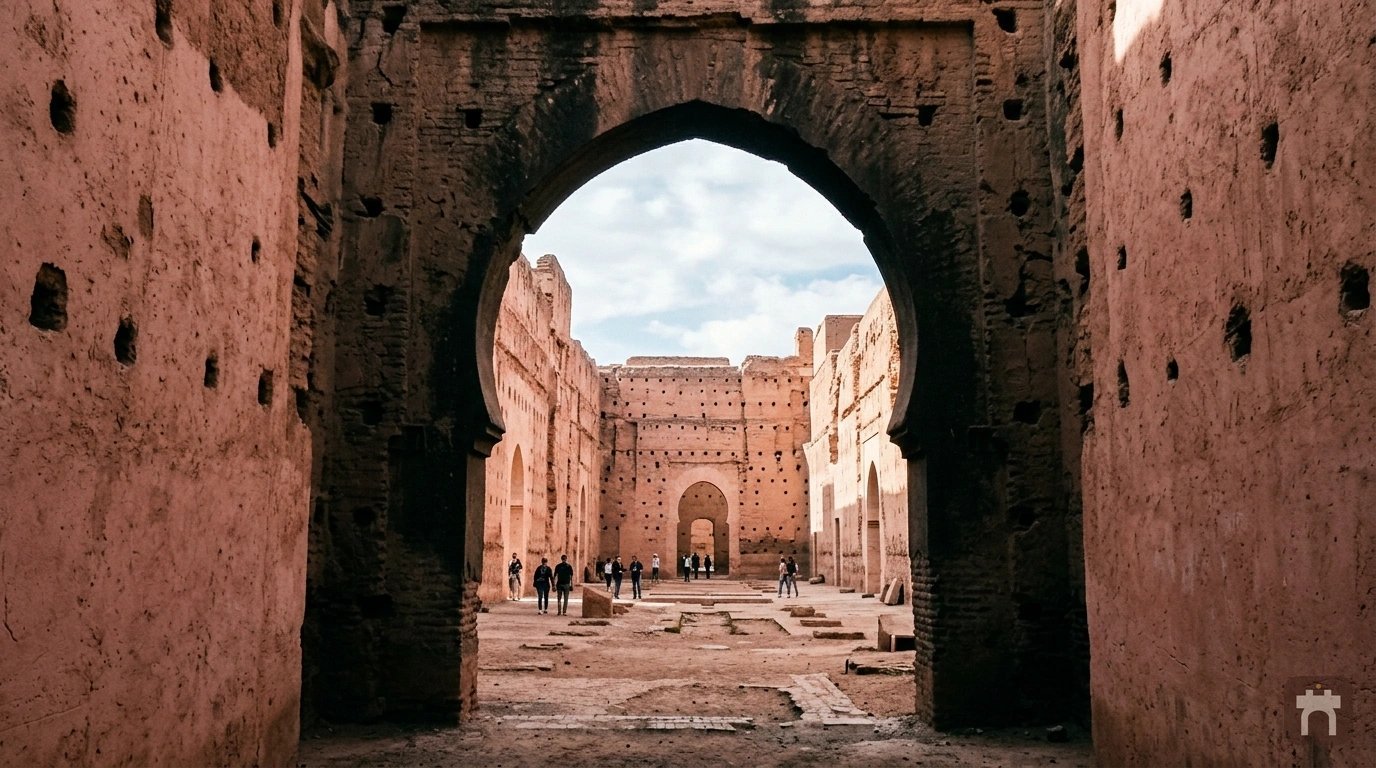
When visitors first walk through the gates of El Badi Palace, the question almost asks itself: why is Marrakech’s most ambitious royal building nothing but a shell? The courtyards are vast, the proportions are undeniably grand, but the walls are bare pisé, the floors are dust and stubborn grass, and there isn’t a scrap of the marble or gold leaf that once made this the most opulent palace in Morocco. The answer has a name: Moulay Ismail.
A Palace Built to Announce a Kingdom
El Badi was never meant to be modest. Ahmad al-Mansur, the Saadian sultan who commissioned it in 1578, had just won a stunning victory at the Battle of the Three Kings, a battle in which three monarchs died and Morocco emerged as a serious regional power, flush with ransom gold and international prestige. Al-Mansur wanted a palace that matched the moment, and for around twenty-five years, resources poured in from across his trading networks: gold carried north by caravan from Timbuktu, and Carrara marble shipped in from Italy, reportedly exchanged weight-for-weight with Moroccan sugar. The result, when finished, was a complex of some 360 rooms surrounding a courtyard 135 by 110 metres, with a reflecting pool stretching nearly 90 metres and sunken gardens planted with orange trees. Contemporaries were suitably awed; the palace’s name, El Badi, means “the Incomparable” for a reason.
A Century of Glory, Then a Sultan With Other Plans
Al-Mansur’s Saadian dynasty didn’t last much longer than his own reign. By the late 17th century, power in Morocco had passed to the Alaouite dynasty, and its most consequential ruler, Sultan Moulay Ismail, had a very different vision for where Morocco’s grandeur should be displayed. Moulay Ismail, who ruled from 1672 to 1727, decided to move his capital away from Marrakech to Meknes, and he wanted that new city built on a scale to rival — or better, surpass — anything the Saadians had left behind, El Badi included.
Rather than commission fresh materials at fresh expense, Moulay Ismail took the more efficient route: he ordered El Badi dismantled. Over roughly a decade, the palace’s marble columns, cedar ceiling beams, gilded stucco, and painted tilework were pried loose, loaded onto carts, and hauled north to Meknes, where they were reassembled into Ismail’s own showcase palaces and monumental gates. It’s a strange kind of tribute — Meknes’ finest architectural flourishes are, in more than a few cases, literally recycled from El Badi’s ruins.
Why the Sultan Wanted El Badi Gone, Specifically
Historians generally read this as more than simple thrift. El Badi was a Saadian monument, and its scale and beauty stood as a physical reminder of the dynasty Moulay Ismail’s own dynasty had displaced. Stripping it bare wasn’t only about acquiring free building materials; it was also a deliberate act of erasing a rival legacy, transferring its glory — literally, brick by brick — to a new capital built in the new ruling family’s name. There’s a long tradition across Moroccan and wider Islamic history of rulers repurposing the monuments of their predecessors, and Moulay Ismail’s treatment of El Badi is one of its most thorough examples.
What the Demolition Left Behind
What’s remarkable is what wasn’t taken, or couldn’t be. The palace’s massive rammed-earth (pisé) walls were structural rather than decorative, too integral and too heavy to be worth carting away, so they remained standing, their ochre-red mass slowly weathering under the Marrakech sun for the past three centuries. And in one corner of the complex, a pavilion continued to shelter one genuinely priceless object that Moulay Ismail’s crews evidently left in place: the 12th-century Koutoubia minbar, a masterwork of Cordoban woodcarving, whose survival inside the otherwise gutted palace is one of the more remarkable quirks of El Badi’s history.
Visiting the Ruin Today
Walking through El Badi now, it helps to picture it in reverse: instead of imagining decoration that’s missing, imagine the sheer volume of material that had to be physically removed to leave behind this much empty space. The scale of the courtyard, still framed by the original walls, gives some sense of how large an undertaking the original construction — and the later demolition — really was. White storks now nest along the ramparts where guards once kept watch, and the rooftop terrace offers views toward the Atlas Mountains that al-Mansur’s architects likely designed to be seen from exactly this vantage point.
El Badi’s emptiness, in other words, isn’t a gap in the story. It is the story: a palace built to declare a kingdom’s power, and then dismantled to declare another kingdom’s power in a different city. Few ruins anywhere make the logic of political succession quite so visible.
Frequently Asked Questions
When did Moulay Ismail strip El Badi Palace? Sultan Moulay Ismail dismantled El Badi Palace in the decades after 1672, once he had moved Morocco’s capital to Meknes, carting off marble, cedar beams, and tilework over roughly a decade to build his new palaces there.
Why didn’t Moulay Ismail take the pisé walls too? The rammed-earth (pisé) walls were structural rather than decorative — far too heavy and integral to the building to be worth transporting, which is why they still stand today while the interior decoration is gone.
Is anything original still inside El Badi Palace? Yes — the 12th-century Koutoubia minbar, a carved wooden pulpit from Córdoba, survives in its own pavilion and is the single most significant original object still on site. For current opening hours and El Badi Palace tickets, see our tickets page.