
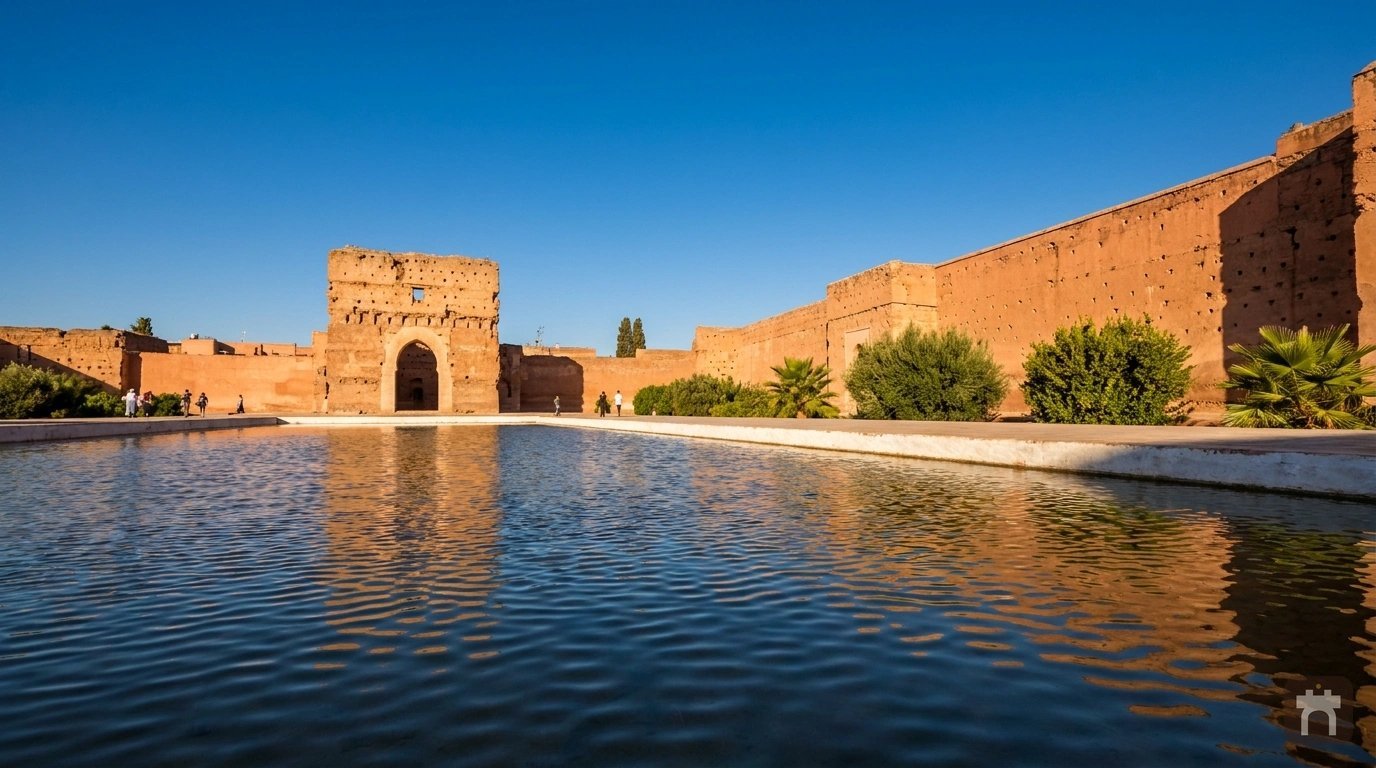
Marrakech’s Kasbah district packs two of the city’s most visited palaces within about ten minutes’ walk of each other, and travellers with limited time often want a straight answer: if you can only see one, which should it be? The honest answer is that El Badi and Bahia Palace are different enough in character that comparing them isn’t really an apples-to-apples exercise — but here’s how they stack up, and why, if your schedule allows it, seeing both back-to-back is worth the effort.
Two Different Kinds of Grandeur
El Badi, built from 1578 by the Saadian sultan Ahmad al-Mansur, was a royal palace designed to project imperial power after a major military victory. What survives today is a ruin: a vast open courtyard, roofless pisé walls, a long reflecting pool, sunken orange gardens, and a rooftop terrace with Atlas Mountain views. Almost none of its original decoration remains in place — it was stripped out in the late 17th century by Sultan Moulay Ismail to furnish his new capital at Meknes. What El Badi offers instead is scale, atmosphere, and a sense of history’s passage: white storks nesting on the ramparts, sun on ochre-red earthen walls, and the surviving 12th-century Koutoubia minbar housed in its own pavilion.
Bahia Palace tells almost the opposite story. Built roughly three centuries later, in the late 19th century, for the powerful vizier Si Moussa and expanded by his son Bou Ahmed, it was designed as a private residence rather than a monument to military conquest, and — crucially — it was never stripped. Its cedar ceilings are still carved and painted in their original colors, its zellige tilework is intact, and its sequence of courtyards and reception rooms still gives a genuine sense of how a wealthy 19th-century Moroccan household actually lived.
Which Palace Suits Which Traveller
If you’re drawn to atmosphere, ruins, and photography — particularly golden-hour light on old walls, or the novelty of storks nesting on a royal building — El Badi is likely to be the more memorable stop. Its open-air courtyard also makes it noticeably easier to enjoy on a quiet morning before tour groups arrive, and the entry fee (100 MAD for foreign visitors) covers both the rooftop terrace and the minbar pavilion.
If you’re more interested in decorative arts, architecture, and getting a concrete sense of how a Moroccan palace actually looked when it was finished and furnished, Bahia Palace is the stronger choice. Its painted ceilings and tiled courtyards are exactly the kind of intact craftsmanship that El Badi’s ruined halls can only hint at. Bahia also tends to draw larger tour groups, particularly in the mid-morning to early afternoon window, so its courtyards can feel busier than El Badi’s more open spaces.
Why Not Both?
Given they’re roughly a 10-minute walk apart, and both sit close to the Saadian Tombs as well (about 8 minutes from El Badi), most visitors with even a half-day to spare in the Kasbah district end up seeing all three. A practical order that works well: start at El Badi in the morning, when the light is best and the crowds are thinnest, spend an unhurried hour or so in its courtyard and rooftop, then walk over to Bahia Palace to see the intact decoration you won’t find at El Badi, finishing at the Saadian Tombs if time and energy allow.
The Bottom Line
There’s no wrong choice between El Badi and Bahia Palace, because they’re not really competing for the same experience. El Badi rewards visitors who want scale, ruin, and atmosphere — the visible aftermath of a dynasty’s rise and a rival sultan’s deliberate erasure of it. Bahia Palace rewards visitors who want intact craftsmanship and a sense of domestic, rather than imperial, grandeur. Seen together, in either order, they form a more complete picture of Marrakech’s palace architecture than either can offer alone — which is exactly why so many visitors end up doing both in a single morning.
Frequently Asked Questions
Is Bahia Palace better than El Badi Palace? Neither is objectively better — they show different things. Bahia Palace has intact painted ceilings and tiled courtyards, while El Badi is a bare ruin valued for its scale, atmosphere, and nesting storks.
Can I visit both El Badi Palace and Bahia Palace in one day? Yes, easily. The two sites are roughly a 10-minute walk apart, and most visitors combine them with the nearby Saadian Tombs in a single morning.
Which should I visit first, El Badi or Bahia Palace? Visit El Badi first thing in the morning for the best light and smallest crowds, then walk to Bahia Palace, which tends to get busier from mid-morning onward. Check current entry prices on our El Badi Palace tickets page.