
I spent close to ninety minutes inside El Badi Palace and still felt like I could have used another twenty, mostly because several of the best parts sit away from the main courtyard where most visitors linger. Here’s a walkthrough of what’s actually inside, roughly in the order you’re likely to encounter it.
The Main Courtyard and Reflecting Pool
This is what most photos of El Badi Palace show: a vast rectangular courtyard, about 135 by 110 metres, lined with towering pisé walls pockmarked with small arched niches. A reflecting pool close to 90 metres long runs along one edge, and on a still morning the walls mirror almost perfectly in the water. Storks nest directly on the ramparts above — a detail that surprises a lot of first-time visitors, who don’t expect wildlife to be part of the draw.
The Sunken Orange Gardens
Below the main courtyard level, sunken gardens still hold mature orange trees, planted as part of the original design. Walking down the stairs into this section, the temperature actually drops slightly under the tree cover, and it’s one of the few genuinely shaded spots on the whole site.
The Excavated Zellij Courtyard
In one section, archaeological work has exposed the original floor level, well below where visitors walk today. Low pisé partition walls trace out the original room layout, and patches of green-and-white zellij tilework are still visible in the ground between them — a rare direct look at the palace’s original decorative flooring, rather than just the bare structural walls seen everywhere else.
The Minbar Pavilion
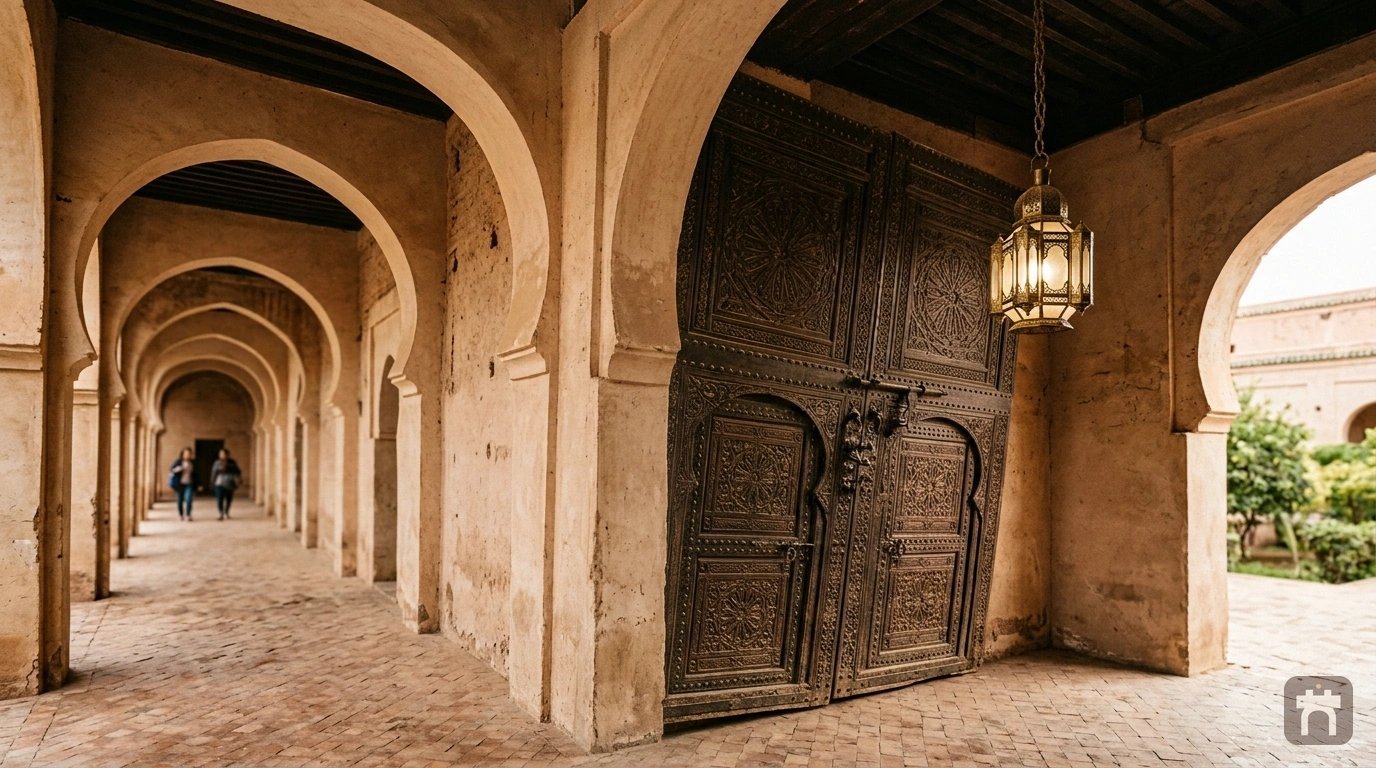
Set slightly apart from the main courtyard, a modest pavilion with a heavy carved wooden door and a hanging metal lantern houses the Koutoubia minbar — a wooden pulpit carved in Córdoba around 1137 for Marrakech’s Koutoubia Mosque, centuries older than the palace itself.
That door, pictured above, is worth pausing at even before you go inside — the carving and ironwork are a level of craftsmanship you don’t see anywhere else on site, since almost everything else this fine was stripped out centuries ago. I go into the minbar’s own story in more depth in a separate piece on the Koutoubia minbar.
The Drained Checkerboard Basin
Near the main pool, a smaller, drained basin retains its original green-white-and-black checkerboard mosaic tiling across the entire floor. It’s a striking, purely geometric pattern that’s easy to miss if you’re focused on the larger reflecting pool nearby.
The Underground Gallery
This is the one I’d flag as most likely to get skipped. A vaulted, cave-like corridor runs beneath part of the complex, its curved pisé ceiling now hung with framed black-and-white photographs documenting old Marrakech — market scenes, portraits, street life from another era.
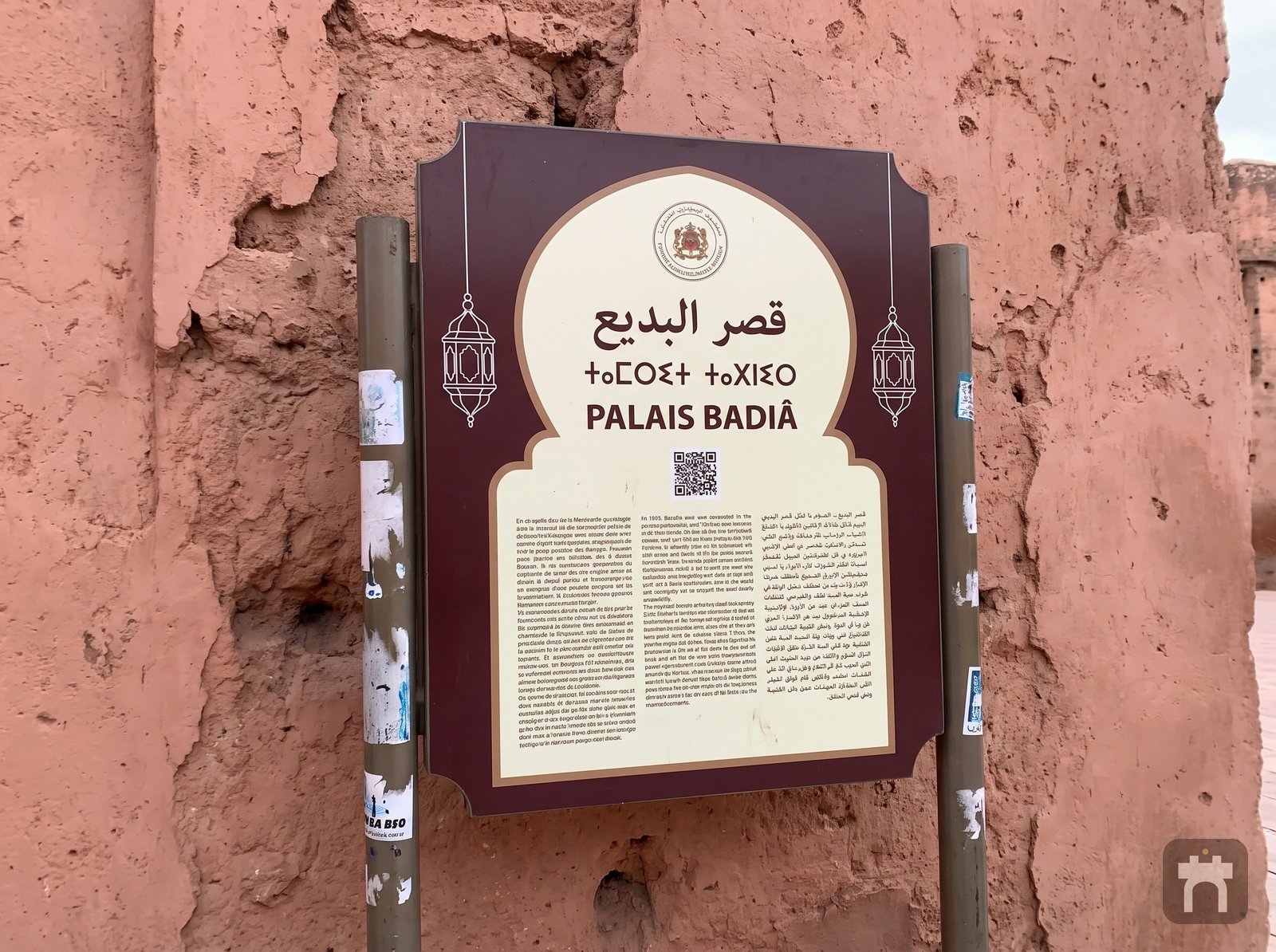
Walking through it feels almost like a detour into a different building entirely, cool and dim after the bright open courtyard, and most visitors moving quickly between the pool and the rooftop terrace walk right past the entrance.
The Checkered Stairs
A set of black-and-white checkered marble stairs connects different levels of the site near the excavated areas — a small but photogenic detail that shows up in a lot of visitors’ photos without them necessarily knowing what it’s called.
The Rooftop Terrace
A staircase leads up to a rooftop terrace with panoramic views across the whole complex and, on a clear day, toward the Atlas Mountains in the distance. It’s included in the standard ticket and, in my view, shouldn’t be skipped — it’s the only vantage point that makes the true scale of the courtyard and surrounding ramparts obvious all at once.
Planning Your Visit Around These Highlights
If you’re short on time, prioritize the main courtyard, the minbar pavilion, and the rooftop terrace — those three alone justify the visit. With a full 90 minutes, add the underground gallery and the excavated zellij courtyard. For a broader sense of whether all of this adds up to a worthwhile stop on your Marrakech itinerary, see is El Badi Palace worth visiting, and for the architectural context behind what you’re looking at, our El Badi Palace architecture guide.
Frequently Asked Questions
What is the most important thing to see at El Badi Palace? The Koutoubia minbar, a 12th-century carved wooden pulpit displayed in its own pavilion, is generally considered the single most historically significant object on the site.
Is the underground gallery at El Badi Palace worth visiting? Yes — it’s a vaulted corridor displaying black-and-white photographs of old Marrakech, and it’s easy to miss since it sits apart from the main courtyard and pool.
Can you go up to the roof at El Badi Palace? Yes, a rooftop terrace is accessible via a staircase and offers panoramic views over the whole complex, included with the standard El Badi Palace tickets.